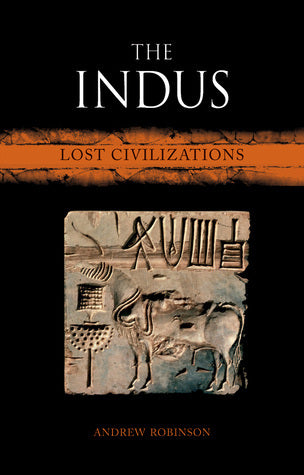
The Indus by Andrew Robinson
The Indus by Andrew Robinson
🚚 ক্যাশ অন ডেলিভারি সারা বাংলাদেশ 🕒 ৭২ ঘন্টার মধ্যে সারা দেশ এ ডেলিভারি
Couldn't load pickup availability
The Indus by Andrew Robinson
Because the Indus Valley Civilization left behind no towering stone monuments like the Egyptian pyramids or royal palaces like those in Mesopotamia, its history is often glossed over in standard Western textbooks. Robinson structures the book to decode this "silent" empire by focusing on its peerless urban infrastructure and social organization:
1. The Great Rediscovery
Robinson opens with a thrilling historiographical account of how the civilization was accidentally stumbled upon in the 19th and early 20th centuries. He chronicles the work of British explorer Charles Masson, the building of the East Indian Railway (where ancient Harappan bricks were tragically crushed to lay train tracks), and the definitive excavations in the 1920s led by Sir John Marshall, which officially introduced the Indus civilization to modern science.
2. Metropolis Without Master: The Great Cities
The text details the astonishing architectural layouts of major hubs like Harappa, Mohenjo-daro, and the port city of Lothal. Robinson explores their hallmark features:
-
The Grid System: Cities were built using uniform, kiln-baked mud bricks laid out in perfect, orthogonal grid patterns, displaying an elite tier of municipal planning.
-
The World's First Sanitation Systems: Virtually every house possessed a private bathing area and a toilet connected to a covered, brick-lined street drainage network that surpassed anything seen in Europe until the 19th century.
-
The Citadel and Lower Town: Cities were divided into distinct zones, featuring raised public platforms like the fabled Great Bath of Mohenjo-daro and massive communal granaries.
1. An Empire Without a King?
The most radical theme Robinson tackles is the complete absence of centralized elite iconography. Excavations have uncovered no statues of grand pharaohs, no lavish royal tombs filled with gold, no weapon storehouses, and no wall reliefs depicting bloody military triumphs. Robinson explores whether the Indus was an egalitarian society run by merchant guilds, a collective of priest-bureaucrats, or a loose confederation of peaceful city-states.
2. Hyper-Standardization
Despite stretching across nearly 500,000 square miles, the Indus civilization displayed an eerie, uniform standard of technology. Robinson examines their sophisticated, highly precise system of weights and measures (binary at low weights, decimal at higher weights). These exact cube weights were utilized uniformly from the coast of Gujarat to the foothills of the Himalayas, indicating an incredibly tight, peaceful trade network.
Language: English.
Genre: Mythology.
Binding: সেলাই করা বাইন্ডিং
Quality: Premium Quality Books.
Printing: High Quality Printing.
Paper: Eye Friendly paper (Cream White)
Cover: Matt cover (Paperback).