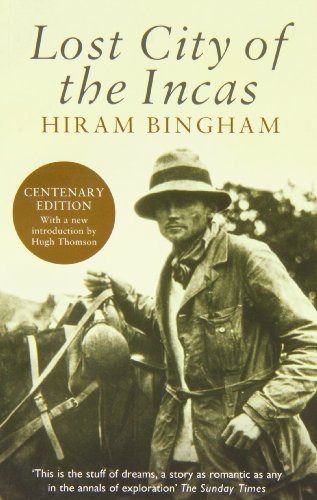
Lost City of the Incas by Hiram Bingham
Lost City of the Incas by Hiram Bingham
🚚 ক্যাশ অন ডেলিভারি সারা বাংলাদেশ 🕒 ৭২ ঘন্টার মধ্যে সারা দেশ এ ডেলিভারি
Couldn't load pickup availability
Lost City of the Incas by Hiram Bingham
Bingham's book is organized into a chronological travelogue that seamlessly weaves personal survival, geography, and historical speculation into a single narrative.
The book's structure tracks Bingham's obsession with locating the final holdouts of the Inca civilization:
1. The Search for Vilcabamba
The narrative begins with Bingham mapping out the historical backdrop of the Spanish Conquest of Peru. He details his primary mission objective: locating Vilcabamba (the "Lost City of the Incas"), the secret jungle fortress where the last independent Inca emperors waged a fierce guerrilla war against Spanish conquistadors until 1072.
2. The July 24, 1911 Discovery
Bingham walks readers through the treacherous, rain-soaked trek along the Urubamba River. Led by a local Quechua farmer named Melchor Arteaga, Bingham climbed a sheer mountain ridge known as Machu Picchu ("Old Peak"). He describes his shock at finding a massive, beautifully preserved citadel hidden beneath centuries of dense jungle vines and cloud-forest canopy.
While Bingham's descriptions of the landscape are stunning, his academic conclusions were heavily colored by his own biases and the limited archaeological tools of the 1940s.
1. The Myth of the "Lost City"
Bingham famously framed Machu Picchu as an untouched secret, completely forgotten by humanity. Modern historians emphasize that while the Spanish Conquistadors never found it, local indigenous families were actively farming the terraces when Bingham arrived. In fact, graffiti on the walls showed that travelers like Agustín Lizárraga had visited the site years before Bingham did. Bingham’s contribution was not "discovering" it, but introducing it to the global scientific community.
2. The Wrong Identity (Vilcabamba vs. Royal Estate)
Bingham died fiercely believing that Machu Picchu was Vilcabamba, the final military refuge of the Incas. He was wrong. Modern archaeology has proven that the actual ruins of Vilcabamba lie much deeper in the jungle at a site called Espíritu Pampa. Machu Picchu was actually built around 1450 CE by Emperor Pachacuti as a seasonal, elite royal estate and spiritual sanctuary—not a military fortress.
Language: English.
Genre: Mythology.
Binding: সেলাই করা বাইন্ডিং
Quality: Premium Quality Books.
Printing: High Quality Printing.
Paper: Eye Friendly paper (Cream White)
Cover: Matt cover (Paperback).