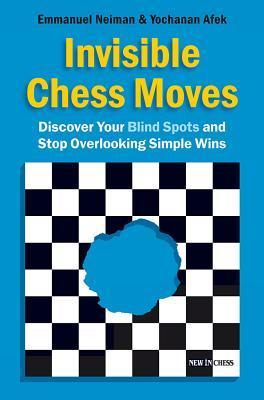
Invisible Chess Moves: Discover Your Blind Spots and Stop Overlooking Simple Wins by Emmanuel Neiman
Invisible Chess Moves: Discover Your Blind Spots and Stop Overlooking Simple Wins by Emmanuel Neiman
🚚 ক্যাশ অন ডেলিভারি সারা বাংলাদেশ 🕒 ৭২ ঘন্টার মধ্যে সারা দেশ এ ডেলিভারি
Couldn't load pickup availability
Invisible Chess Moves: Discover Your Blind Spots and Stop Overlooking Simple Wins by Emmanuel Neiman
Invisible Chess Moves: Discover Your Blind Spots and Stop Overlooking Simple Wins (2011), co-authored by FIDE Master Emmanuel Neiman and International Master/Endgame Study Composer Yochanan Afek, is widely considered a modern tactical classic. It even won the prestigious ChessCafe Book of the Year award.
The core premise is fascinating: Why do strong human players (even Grandmasters) routinely miss simple, short, 1-to-2 move tactics?
Neiman and Afek argue that our brains are not computers; we rely on mental shortcuts, heuristics, and rules of thumb. Because of this, our brains actively filter out and "block" certain legal moves before we even consciously consider them. The book categorizes these hidden moves into two main domains: Objective Invisibility (how the geometry of the board tricks us) and Subjective Invisibility (how our own psychological and positional biases blind us).
Core Framework of the Book
1. Objective Invisibility: Geometrically Hard-to-See Moves
These are moves that our eyes naturally struggle to track due to the physical layout of the chessboard and the way pieces move.
-
Backward Attacking Moves: Humans naturally look forward when attacking. Moving a piece backward (especially a long, diagonal retreat by a Queen or Bishop) to deliver a lethal blow or cross-wing attack is highly counter-intuitive.
-
Backward Knight Moves: Because the Knight moves in an "L" shape, tracking its retreat paths to offensive squares is one of the most common visual blind spots.
-
Horizontal Effects: We are highly trained to look at vertical files and diagonals, but long, sweeping horizontal moves (like a Rook swinging from a2 to h2) are frequently overlooked.
-
Quiet Moves in Explosive Positions: When a position is highly chaotic, our brains screen for checks, captures, and direct threats. A cold, subtle "quiet move" that creates a slow but unstoppable threat is often completely invisible.
Language: English.
Genre: Chess Book.
Binding: সেলাই করা বাইন্ডিং
Quality: Premium Quality Books.
Printing: High Quality Printing.
Paper: Eye Friendly paper (Cream White)
Cover: Matt cover (Paperback).