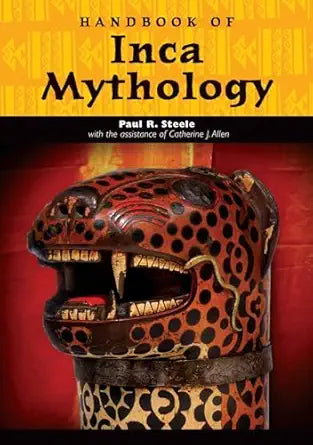
Handbook of Inca Mythology (World Mythology) by Paul Richard Steele , Catherine Jean Allen
Handbook of Inca Mythology (World Mythology) by Paul Richard Steele , Catherine Jean Allen
🚚 ক্যাশ অন ডেলিভারি সারা বাংলাদেশ 🕒 ৭২ ঘন্টার মধ্যে সারা দেশ এ ডেলিভারি
Couldn't load pickup availability
Handbook of Inca Mythology (World Mythology) by Paul Richard Steele , Catherine Jean Allen
The handbook approaches the Inca cosmos not as a collection of dead fairy tales, but as a living, spatial reality where geography, architecture, and religion were seamlessly unified. The book is organized into functional, academic sections:
1. Historical Background & The Sourcing Dilemma
The introduction provides an essential critique of our surviving primary texts. Steele and Allen walk readers through the various types of colonial accounts, analyzing the works of Spanish soldiers, Christian priests, and crucial indigenous/mestizo chroniclers like Inca Garcilaso de la Vega and Felipe Guaman Poma de Ayala. The authors teach readers how to spot "Europeanization"—the common colonial tendency to force complex Andean concepts into rigid Western frameworks (such as rewriting the creator god Viracocha to look exactly like the Christian God).
2. Chronology of the Andean World
The book outlines the grand cyclical ages of the Andean universe, focusing heavily on the overarching concept of Pachakuti—a cataclysmic cosmic overturning that clears out the old world to birth a completely new era. The timeline traces:
-
The Primordial Creation: The god Viracocha emerging from the dark waters of Lake Titicaca to fashion the sun, moon, stars, and the first prototype humans out of stone.
-
The Dynastic Origins: The legendary emergence of the founding ancestors—the Ayar Brothers and their sisters—from the sacred cave of Tamputoco, tracking their epic journey to establish the capital city of Cuzco.
Steele and Allen guide the reader to understand the unique, non-Western mechanics that governed Andean cosmic logic:
1. The Living Landscape (Huacas)
A central theme of the handbook is that the Andean universe is intensely animistic. The authors break down the concept of a Huaca—which can be anything that holds an unusual concentration of sacred energy. A huaca could be a colossal snow-capped peak (Apu), an oddly shaped stone in a field, a fresh water spring, or even the preserved mummy of a deceased ancestor. The landscape itself was viewed as a physical, sentient tapestry of spiritual entities that humans had to actively negotiate with through reciprocal offerings of coca leaves, chicha (maize beer), and textiles.
2. The Ceque System: Sacred Spatial Engineering
The handbook features a fascinating analysis of the Ceque System of Cuzco. The Incas imagined their capital city as the literal navel of the universe, from which radiating, invisible lines (ceques) fanned out across the landscape like the spokes of a massive wheel. Along these lines sat hundreds of individual huacas, cared for by specific family clans (ayllus). This turned the entire geography of the empire into a massive, functioning calendar, a social map, and a sacred outdoor temple.
Language: English.
Genre: Mythology.
Binding: সেলাই করা বাইন্ডিং
Quality: Premium Quality Books.
Printing: High Quality Printing.
Paper: Eye Friendly paper (Cream White)
Cover: Matt cover (Paperback).