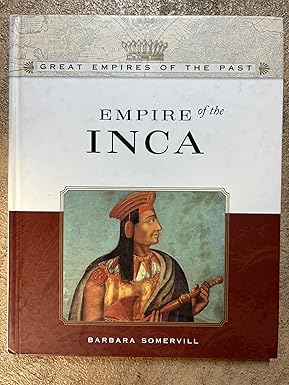
Empire of the Inca (Great Empires of the Past) by Barbara A. Somervill
Empire of the Inca (Great Empires of the Past) by Barbara A. Somervill
🚚 ক্যাশ অন ডেলিভারি সারা বাংলাদেশ 🕒 ৭২ ঘন্টার মধ্যে সারা দেশ এ ডেলিভারি
Couldn't load pickup availability
Empire of the Inca (Great Empires of the Past) by Barbara A. Somervill
The book addresses a profound historical reality: Without the use of the wheel, draft animals, or a graphic writing system, the Incas engineered a highly sophisticated, centralized empire spanning over 2,500 miles along the rugged spine of the Andes Mountains
Part 1: Origins and the Rise of the Sapa Inca
-
The Cradle of the Andes: Exploring the pre-Inca cultures (such as the Tiwanaku and Wari) that laid the agricultural and technological foundations for the region.
-
From Kingdom to Empire: Tracking the legendary origins of the Inca from Manco Cápac to the pivotal reign of Pachacuti (Pachacutec), the visionary ruler who transformed Cuzco from a small chiefdom into the sprawling empire known as Tawantinsuyu (The Land of the Four Quarters
Part 2: Society, Governance, and Daily Life
-
The Ayllu and Social Hierarchy: A deep look at the strict social pyramid, from the semi-divine Sapa Inca (Emperor) and the noble Capac Incas down to the Ayllu—the fundamental community unit based on shared land, collective farming, and mutual obligation.
-
The Mita System: Explaining the innovative state labor tax. Instead of paying with currency, citizens contributed physical labor to construct roads, terraces, and fortresses in exchange for state-provided food, clothing, and security.
-
The Incan Religion: Detailing the worship of Inti (the Sun God) and Viracocha (the Creator), the preservation of royal mummies, and the sacred geography of huacas (holy natural sites).
1. It Celebrates a Alternative Form of Innovation
Western history often measures the "advancement" of a civilization by its use of the wheel or an alphabet. Somervill demonstrates that the Incas developed brilliant alternative solutions to match their extreme environment. By mastering stone masonry (shaping massive stones that fit together perfectly without mortar to survive earthquakes) and inventing the quipu, they achieved an elite level of imperial organization that rivaled the Roman Empire without following a traditional European evolutionary path.
2. It Unpacks the Complexity of Inca State Socialism
The book explains how the Inca government operated on a strict system of reciprocity. While the common people surrendered their personal freedoms and a portion of their labor to the Sapa Inca, the empire guaranteed that no citizen went hungry, naked, or unprotected. Somervill outlines this delicate social contract, showing how the state successfully eliminated poverty while maintaining complete authoritarian control.
Language: English.
Genre: Mythology.
Binding: সেলাই করা বাইন্ডিং
Quality: Premium Quality Books.
Printing: High Quality Printing.
Paper: Eye Friendly paper (Cream White)
Cover: Matt cover (Paperback).