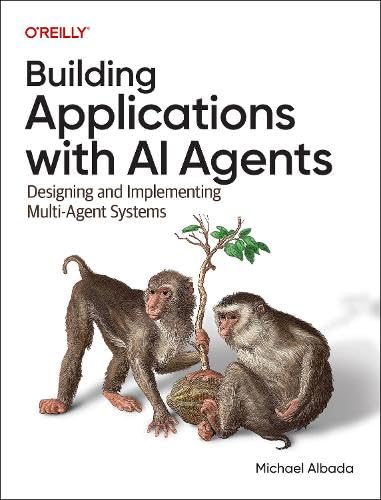
Building Applications with AI Agents: Designing and Implementing Multiagent Systems by Michael Albada
Building Applications with AI Agents: Designing and Implementing Multiagent Systems by Michael Albada
🚚 ক্যাশ অন ডেলিভারি সারা বাংলাদেশ 🕒 ৭২ ঘন্টার মধ্যে সারা দেশ এ ডেলিভারি
Couldn't load pickup availability
Building Applications with AI Agents: Designing and Implementing Multiagent Systems by Michael Albada
The text targets the core challenge of modern AI engineering: How do we build reliable, multi-step systems using probabilistic Large Language Models? Albada breaks down agent development into modular components, proving that production-grade automation requires rigorous software architecture, clear state boundaries, and real-time observability.
-
The Agentic Design Pattern: Transitioning from simple text completion or static RAG (Retrieval-Augmented Generation) pipelines into active, self-correcting inference chains.
-
The Blueprint of an Agent: Deconstructing the central nervous system of an agent into its fundamental building blocks: Foundation Models (the reasoning core), Memory (short-term state tracking and long-term semantic persistence), and Skills (hand-crafted, API-based, or plugin-driven tools).
Many developers find themselves locked into a single software library (like LangChain) without understanding the underlying design philosophy. Albada’s repository architecture changes this game entirely. By utilizing a unified scenario specification that splits into parallel implementations across LangGraph, AutoGen, and raw OpenAI SDK code, he teaches developers to master the design patterns rather than getting trapped in framework-specific abstractions.
When an autonomous agent fails in production, it rarely prints a simple stack trace. It often enters an expensive "infinity loop"—hallucinating tool parameters, executing failing code over and over, and burning thousands of dollars in API token costs. Albada directly addresses this operational bottleneck by showing architects how to build child-parent traces, map dependencies via OpenTelemetry, and pinpoint the exact token mutation that caused the execution breakdown.
Language: English.
Genre: Applied Artificial Intelligence.
Binding: সেলাই করা বাইন্ডিং
Quality: Premium Quality Books.
Printing: High Quality Printing.
Paper: Eye Friendly paper (Cream White)
Cover: Matt cover (Paperback).