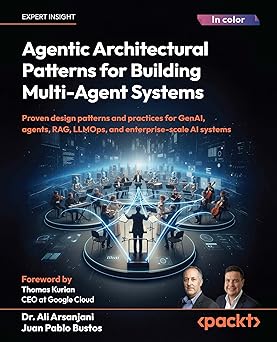
Agentic Architectural Patterns for Building Multi-Agent Systems: by Dr. Ali Arsanjani , Juan Pablo Bustos
Agentic Architectural Patterns for Building Multi-Agent Systems: by Dr. Ali Arsanjani , Juan Pablo Bustos
🚚 ক্যাশ অন ডেলিভারি সারা বাংলাদেশ 🕒 ৭২ ঘন্টার মধ্যে সারা দেশ এ ডেলিভারি
Couldn't load pickup availability
Agentic Architectural Patterns for Building Multi-Agent Systems: Proven design patterns and practices for GenAI, agents, RAG, LLMOps, and enterprise-scale AI systems by Dr. Ali Arsanjani, Juan Pablo Bustos
The book addresses the fundamental challenge facing modern AI engineering: Large Language Models (LLMs) are stochastic (probabilistic), but enterprise software must be deterministic (reliable). The authors argue that reliability in generative AI is primarily an architectural property rather than a model property.
-
The GenAI Maturity Model: A structured framework helping organizations benchmark their current AI capabilities and navigate a clear technical path toward fully autonomous agentic workflows.
-
Agent-Ready LLMs: Strict criteria for selecting, optimizing, and deploying foundational models specifically for agentic environments, alongside the emergence of AgentOps and LLMOps.
-
The Three-Layer Agentic Stack: Introducing the layers required for modern distributed intelligence: Function Calling, Tool Protocols (such as Model Context Protocol / MCP), and Agent-to-Agent (A2A) collaboration networks.
As organizations move away from simple chat interfaces and try to build autonomous AI systems, Agentic Architectural Patterns provides the formal software engineering discipline that the field heavily lacks.
Many developers build agent systems using loose, highly unpredictable prompt loops that fail under real-world conditions. Dr. Arsanjani—frequently recognized as the "father of Service-Oriented Architecture (SOA)"—uses his decades of enterprise software experience to bring classic, loose-coupling architectural patterns to LLMs, transforming unpredictable prompt engineering into predictable software infrastructure.
The book is one of the earliest technical volumes to fully map out and codify the Agent-to-Agent (A2A) protocol. Rather than building massive, monolithic agents that try to perform every corporate task (and fail due to context window limitations), the text establishes the blueprints for running distributed, specialized networks of micro-agents that communicate, negotiate, and allocate resources just like modern microservice architectures.
For industries like banking, healthcare, and insurance, fully autonomous AI introduces massive legal, data safety, and compliance risks. This book is widely celebrated because it does not ignore these problems; it dedicates entire chapters to compliance patterns like Instruction Fidelity Auditing and Persistent Instruction Anchoring, ensuring that agents remain strictly bounded within corporate compliance rules while retaining their problem-solving autonomy.
Language: English.
Genre: Applied Artificial Intelligence.
Binding: সেলাই করা বাইন্ডিং
Quality: Premium Quality Books.
Printing: High Quality Printing.
Paper: Eye Friendly paper (Cream White)
Cover: Matt cover (Paperback).